
Attending a live performance by the Hawaiʻi Symphony Orchestra at the Neal S. Blaisdell Concert Hall is a thrilling cultural experience. For many first-time attendees, the anticipation of hearing a world-class ensemble is occasionally accompanied by a specific type of performance anxiety. This anxiety does not stem from what to wear or where to park, but rather from a highly specific question of concert etiquette. First-time listeners frequently ask themselves when they are actually supposed to clap.
The fear of applauding at the wrong moment causes hesitation among new listeners. No one wants to be the solitary person clapping loudly in the middle of a quiet, emotional musical passage while the rest of the auditorium remains completely silent. Understanding the unwritten rules of concert hall applause removes this hesitation completely. This guide explains the history behind classical music etiquette, how to read the physical cues of the conductor, and how to navigate complex symphonic structures so you can enjoy your next evening at the symphony with absolute confidence.
The Historical Evolution of Concert Applause
If you traveled back in time to attend a premiere of a symphony by Wolfgang Amadeus Mozart or Ludwig van Beethoven, the audience behavior would shock modern sensibilities. During the eighteenth and early nineteenth centuries, classical concerts were highly interactive social events. Audiences treated symphonies much like modern crowds treat jazz performances. If the orchestra executed a particularly thrilling passage or a soloist delivered a virtuosic flourish, the audience erupted into spontaneous applause and cheering right over the music.
Mozart actively encouraged this interactive behavior. In his personal letters, he frequently boasted about which specific musical phrases elicited the loudest cheers from the crowd during his premieres. Composers designed their symphonies with built-in pauses to allow the audience enough time to clap before the musicians continued playing the next section.
The shift toward strict silence occurred during the late nineteenth century. Composers like Richard Wagner and Gustav Mahler began writing massive, emotionally heavy works that required deep concentration from both the performers and the listeners. Wagner famously asked his audiences not to applaud during the performance of his opera Parsifal to preserve the sacred, serious atmosphere of the storytelling. Over the next few decades, this request for silence spread across Europe and the United States. It eventually cemented the modern standard rule that audiences must remain completely quiet until the final note of the entire composition fades away.
Understanding Movements Within a Symphony
The primary source of applause confusion stems from the structural design of classical music. Most major classical compositions are divided into separate, distinct sections called movements. You can think of a symphony as a novel, with the individual movements acting as the chapters within that novel. Between each movement, the orchestra stops playing entirely. The conductor lowers their arms, the musicians turn the pages of their sheet music, and a few moments of absolute silence fill the auditorium.
To a newcomer, this pause sounds exactly like the end of the song. The golden rule of modern classical etiquette dictates that the audience should hold their applause during these internal pauses and wait until the final movement concludes. Applauding between movements disrupts the emotional momentum the composer intended to build across the entire work.
| Symphony Section | Tempo and Style | Emotional Purpose |
|---|---|---|
| First Movement | Fast and vigorous | Introduces the primary musical themes and establishes the core dramatic conflict of the piece. |
| Second Movement | Slow and lyrical | Provides emotional contrast through beautiful, sustained melodies and quiet reflection. |
| Third Movement | Dance-like or rhythmic | Offers a lighter transition historically based on a minuet or scherzo dance form. |
| Fourth Movement | Fast and triumphant | Resolves the musical conflict and drives the symphony toward a massive, definitive conclusion. |
How to Know When the Piece is Actually Over
Keeping track of movements requires a bit of preparation before the conductor steps onto the podium. The easiest way to know exactly when a piece will end is to consult the printed program provided by the ushers in the lobby.
The program notes list every piece the orchestra will perform that evening. Underneath the title of the composition, you will see a numbered list of the movements, often titled with Italian tempo markings like Allegro, Adagio, or Presto. By counting the pauses between the sections, you can track exactly where the orchestra is within the timeline of the piece. If the program lists four movements, you know you must wait through three complete pauses before you can safely applaud.
If you lose track of the counting, you can rely on the auditory cues written into the music. Composers generally signal the true end of a symphony by writing a finale that builds in volume and intensity. A final movement often concludes with a series of massive chords played by the entire ensemble, signaling a definitive resolution. However, some pieces end quietly by fading away into nothingness, which is why visual cues become just as critical as auditory clues.
| Tracking Strategy | Execution Method | Reliability Level |
|---|---|---|
| Reading the Program | Counting the number of movements listed under the title of the piece before the music begins. | Highly reliable, provided you do not lose count during the performance. |
| Listening for Resolution | Waiting for a massive, triumphant chord progression that signals finality. | Moderately reliable, as some composers write false endings to trick the ear. |
| Watching the Performers | Observing the physical relaxation of the musicians and the conductor on stage. | Extremely reliable, as the performers dictate the exact moment the tension breaks. |
Reading the Conductor and the Musicians
When the music stops, the physical body language of the artists on stage provides the most reliable indicator of whether you should clap. The conductor controls the flow of time within the concert hall. As long as the conductor keeps their hands or baton suspended in the air, the music is technically still happening, even if the hall is completely silent. This suspended silence is a deliberate artistic choice designed to let the final chord resonate and fade naturally into the acoustic space of the auditorium.
You can also watch the individual musicians to gauge the status of the piece. During a pause between movements, violinists will keep their instruments tucked firmly under their chins, and woodwind players will keep their instruments resting near their mouths. They remain frozen in a posture of readiness.
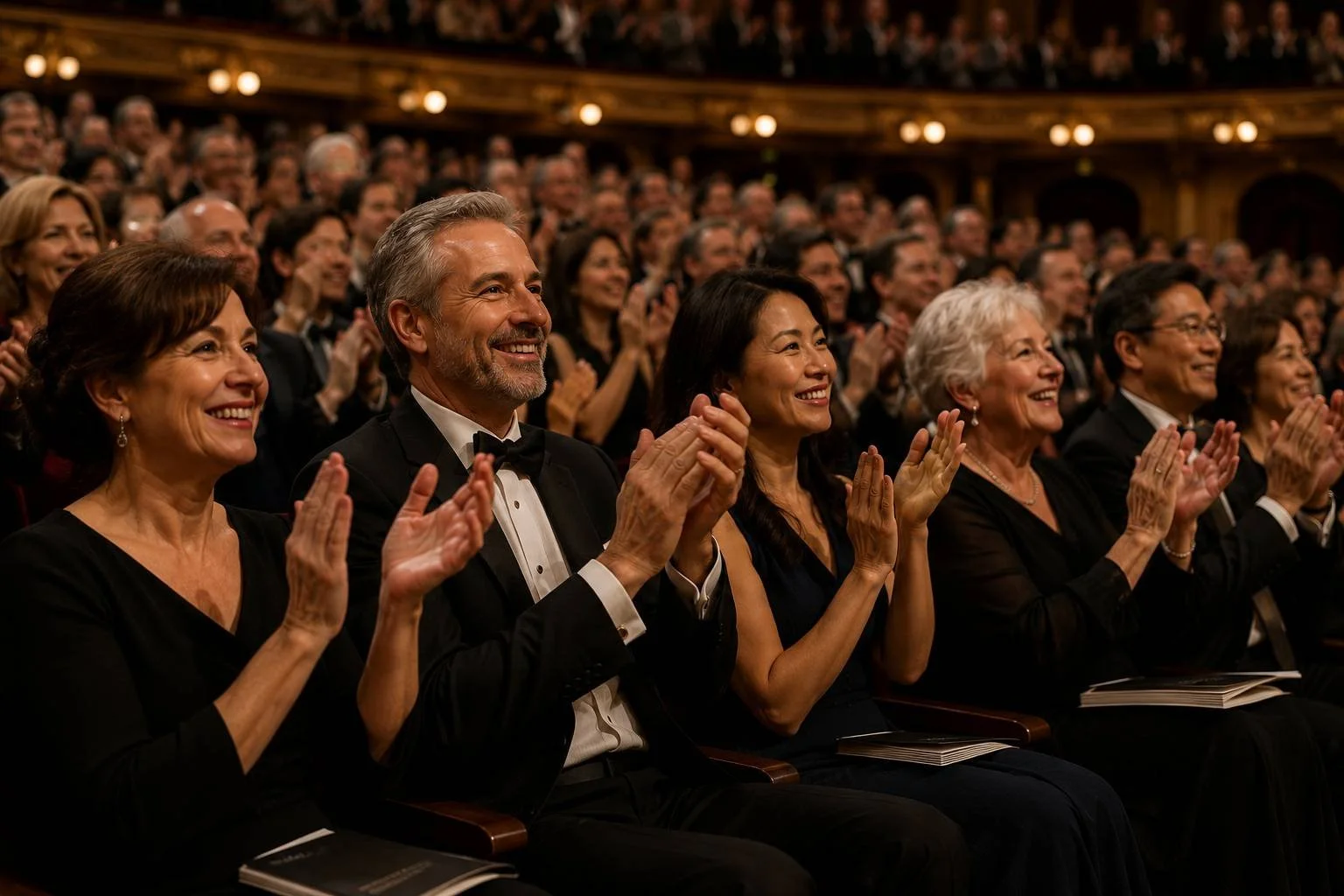
When the entire piece is truly over, the physical tension on the stage evaporates. The conductor lowers their arms completely, relaxes their shoulders, and steps off the podium to turn around and face the audience. Simultaneously, the musicians lower their instruments to their laps. Once the conductor turns to face the crowd, the artistic spell is broken, and you are free to applaud as loudly as you wish.

The conductor bowing signals the true end of the performance. Source: Bettmann / Bettmann Archive
Exceptions to the Silence Rule
While the rule of holding applause until the very end applies strictly to symphonies and concertos, different genres of live orchestral music carry entirely different expectations. Understanding these exceptions will help you navigate a wide variety of programming at the concert hall without second-guessing yourself.
If you attend a ballet or an opera, the rules revert closer to the interactive norms of the eighteenth century. When an opera singer finishes a particularly difficult and emotional aria, the orchestra will often pause specifically to allow the audience to cheer. During a ballet presentation, audiences routinely applaud when a principal dancer executes a stunning leap or completes a complex series of turns.
Similarly, if you attend a jazz performance or a popular music concert featuring the symphony orchestra, clapping is encouraged throughout the performance. Whenever a guest instrumentalist finishes a spectacular improvised solo, it is customary to applaud immediately, even while the rest of the ensemble continues playing the underlying groove.
Finally, if you or someone near you accidentally claps between movements during a classical masterworks concert, do not panic. Seasoned concertgoers and the musicians on stage understand that accidental applause comes from a place of genuine enthusiasm and joy. The Hawaiʻi Symphony Orchestra welcomes listeners of all experience levels, and a misplaced clap is simply a sign that the music moved someone in the audience.
Plan Your Next Visit to the Symphony
Now that you understand the mechanics of concert hall etiquette, you can sit back, relax, and focus entirely on the magnificent sound of a live orchestra. Navigating the movements and reading the conductor becomes second nature after attending just a few performances.
Explore upcoming classical masterworks, exciting guest conductors, and dynamic concert schedules on the official Hawaiʻi Symphony Orchestra Calendar. To secure your seats for an upcoming performance at the Neal S. Blaisdell Concert Hall, visit the HSO Ticketing Portal or browse comprehensive visitor resources on the HSO FAQ Page.