
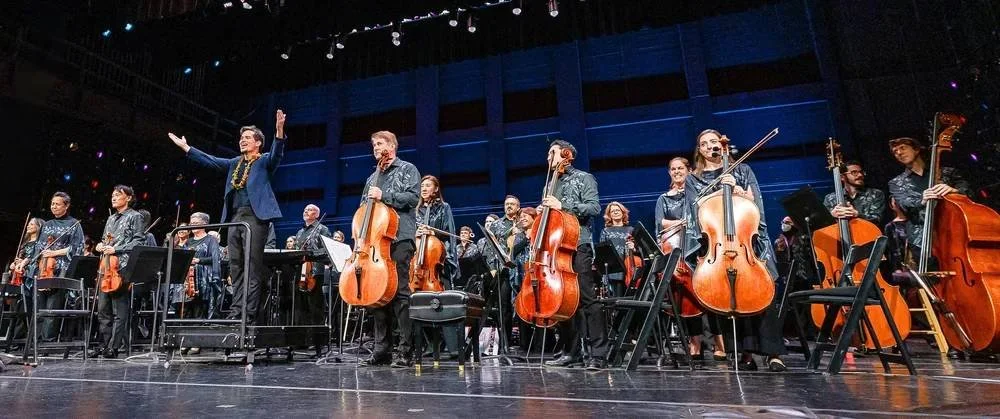
Attending a live classical performance by the Hawaiʻi Symphony Orchestra at the Neal S. Blaisdell Concert Hall offers a magnificent visual spectacle. Looking at the front of the stage, you will notice dozens of musicians holding wooden string instruments tucked neatly under their chins. To the untrained eye, these instruments appear completely identical. They share the same hourglass shape. They feature the same carved wooden scrolls. They possess matching hollow resonant chambers. They are played with similar horsehair bows. Yet, this visual similarity masks a profound musical distinction.
The orchestra relies on two distinct instruments within this specific visual category: the violin and the viola. While they sit adjacent to each other on the stage, they serve entirely different musical purposes. They produce different frequency ranges. They utilize different physical dimensions. They read completely different forms of sheet music. They require specialized physical techniques from the musicians who play them. Understanding the difference between a violin and a viola completely changes how you listen to a symphonic masterwork. This comprehensive guide explores the structural variations, tuning differences, specific orchestral roles, and unique tonal qualities that separate these two essential string instruments.
Physical Size and Structural Dimensions
The most immediate difference between a violin and a viola involves their physical size. If you place the two instruments side by side, the contrast becomes instantly apparent. The violin is the smaller of the two. Over centuries of development, Italian luthiers standardized the full-size violin body to measure approximately fourteen inches in length. This standardized size allows professional violinists to transition between different instruments seamlessly without adjusting their physical technique.
The viola defies this type of strict standardization. Violas are noticeably larger, but their exact dimensions vary significantly. A full-size viola body can measure anywhere from fifteen inches to over seventeen inches in length. The instrument must be larger to resonate lower pitches effectively. However, if a viola were built to perfectly proportional acoustic dimensions for its pitch range, it would be far too large to hold under the chin. Consequently, luthiers build violas in various sizes to accommodate the physical arm length of the specific musician playing it.
| Structural Feature | Full-Size Violin | Full-Size Viola |
|---|---|---|
| Average Body Length | 14 inches | 15 to 17.5 inches |
| Rib Width (Depth) | Narrower profile | Deeper, thicker profile |
| Bow Weight | Lighter (approx. 60 grams) | Heavier (approx. 70 grams) |
| Standardization | Highly standardized | Highly variable based on player |
Because the viola is longer and heavier, it requires a physically demanding approach. Violists must stretch their left-hand fingers considerably wider to hit the correct notes. They also use a slightly heavier bow. The heavier bow helps grip the thicker strings to initiate a resonant sound.
Violinists and violists both utilize specialized accessories to hold their instruments comfortably. A shoulder rest attaches to the back of the instrument, while a chinrest provides a secure anchor point for the jaw. Because violas weigh significantly more than violins, selecting the perfect shoulder rest becomes a critical ergonomic decision for the musician to prevent long-term neck strain during intense performances.
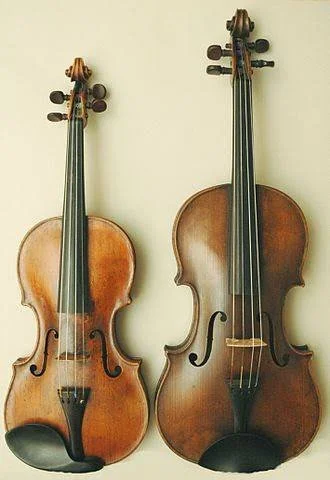
A standard violin alongside a larger viola. Source: Liverpool Academy of Music
String Tuning and Pitch Range
The structural differences directly dictate the musical capabilities of each instrument. Both the violin and the viola feature four strings. The crucial distinction lies in how those specific strings are tuned. This tuning shifts the entire frequency response of the instrument downward into a richer register.
A violin is tuned to the notes G, D, A, and E. The lowest string is the G string. The highest string is the brilliant, piercing E string. This high E string gives the violin its signature soaring quality. It allows the instrument to cut through the heavy acoustic texture of a massive eighty-piece orchestra. Composers rely on the violin to project melodies high above the rest of the ensemble.
The viola is pitched exactly one perfect fifth lower than the violin. Its four strings are tuned to C, G, D, and A. The viola shares its upper three strings with the violin. However, it completely lacks the high E string. Instead, it features a thick, resonant low C string. This low C string fundamentally changes the acoustic nature of the instrument. It anchors the viola in a lower, richer register.
| String Order (Low to High) | Violin Tuning | Viola Tuning |
|---|---|---|
| Lowest String | G | C (One fifth lower than Violin G) |
| Second String | D | G |
| Third String | A | D |
| Highest String | E | A |
Modern strings for both instruments utilize synthetic materials, steel cores, or gut cores wrapped in metallic alloys like silver, aluminum, tungsten, or titanium. These metallic windings add crucial mass to the string. The thick C string on a viola requires a heavy tungsten winding to vibrate slowly enough to produce its cavernous low pitch without becoming loose and unplayable under the bow.
The shared middle strings mean that a violinist and a violist can play the exact same notes in the middle register. Even when they play the exact same pitch, the resulting sound differs. The larger resonant chamber of the viola body colors the note with a deeper acoustic shadow, whereas the violin projects the note with sharp clarity.
The Enigma of the Alto Clef
Because the instruments operate in different pitch ranges, the musicians must read different types of sheet music. If you look over the shoulder of a violinist during a performance, you will see standard treble clef. Treble clef is the most common musical notation system in the Western world. It is the same clef used by flutes, clarinets, trumpets, and the right hand of a piano. The treble clef perfectly accommodates the high-flying range of the violin.
If you look at the sheet music on a violist's stand, you will encounter something entirely different. Violists read music written in the alto clef. The alto clef is a specialized musical symbol used almost exclusively by the viola section. The symbol points directly to the middle line of the musical staff, designating that specific line as "Middle C".

Violists read music utilizing the specialized alto clef.
This unique clef exists out of pure practical necessity. If composers tried to write viola music using the standard treble clef, the notes for the low C string would fall far below the standard musical staff. The composer would have to draw numerous extra lines beneath the staff for every low note. This would make the sheet music cluttered and incredibly difficult to read quickly.
By utilizing the alto clef, the composer perfectly centers the viola's pitch range directly on the staff. This creates a clean, highly legible map for the musician to follow during rapid, complex performances. When the viola occasionally plays exceptionally high notes, the composer will switch the sheet music into treble clef temporarily to prevent the musician from having to read extreme lines hovering far above the alto staff. However, for the vast majority of a symphony, the violist remains comfortably anchored in the alto clef.
Section Roles Within the Symphony Orchestra
The physical and musical differences between the two instruments dictate their specific roles within the symphonic hierarchy. In a traditional orchestra seating arrangement, the violins sit at the very front of the stage. The Hawaiʻi Symphony Orchestra utilizes dozens of violins divided into two separate sections: the First Violins and the Second Violins.
The violins serve as the primary melodic voice of the orchestra. Because their sound projects so clearly, composers assign them the most recognizable themes. When you leave a concert humming a beautiful melody, you are almost always humming a part played by the violin section. They provide the brilliant, shimmering surface of the orchestral sound.
The viola section typically sits directly in the center of the stage or slightly to the right of the conductor. Their role is entirely different. Violas function as the essential harmonic glue of the string family. They bridge the acoustic gap between the bright violins and the deep, rumbling cellos.
| Orchestral Function | Violin Section Role | Viola Section Role |
|---|---|---|
| Primary Responsibility | Melodic leadership | Harmonic support |
| Acoustic Function | Projecting above the ensemble | Blending sections together |
| Seating Location | Front outer edge of the stage | Center interior of the stage |
| Musical Texture | Brilliant surface melodies | Complex inner rhythmic drive |
Without the violas, an orchestra would sound hollow. The violas play complex inner harmonies that thicken the musical texture. String sections frequently employ a technique called divisi, meaning the section splits in half to play two different notes simultaneously. When the viola section plays a divisi passage, they cover an incredibly wide harmonic spread. They provide a lush, velvety carpet of sound that supports the soaring melodies of the violins. While they occasionally receive a featured solo melody, their primary genius lies in collaborative blending.
Tone Color and Emotional Impact
The most subjective yet most profound difference between the violin and the viola involves their tone color. Musicians refer to this unique acoustic fingerprint as timbre. Even to an untrained ear, the two instruments evoke completely different emotional responses.
The violin possesses a bright, brilliant tone. Its upper register sounds radiant. Depending on how the musician applies their bow, the violin can sound intensely joyful, sharply aggressive, delicately sweet, or piercingly dramatic. It is an extroverted instrument designed to command attention from the listener. The high E string acts like a vocal soprano, cutting through heavy orchestration with crystal clarity.
The viola produces a fundamentally introverted sound. Its tone is frequently described as mellow, dark, woody, and chocolatey. Because the instrument's body is technically slightly too small for the low pitches it produces, the sound does not project with the same aggressive brilliance as a violin. Instead, the viola produces a veiled, melancholic resonance.
Composers utilize the viola when they want to evoke feelings of nostalgia, deep sorrow, warm comfort, or quiet reflection. The low C string provides a throaty, rich growl that the violin simply cannot replicate. Masterful composers like Antonín Dvořák, Johannes Brahms, Wolfgang Amadeus Mozart, and Ralph Vaughan Williams wrote extensively beautiful music specifically highlighting the viola. Brahms particularly favored the dark, chocolatey tone of the instrument to anchor the emotional weight of his chamber works.
Experience the Strings Live in Honolulu
Understanding the mechanical and acoustic differences between these two beautiful instruments enhances your listening experience. Once you know what to listen for, you can easily separate the brilliant sheen of the violins from the warm, woody resonance of the violas. The best way to appreciate this complex acoustic relationship is to hear them performed together in a reverberant acoustic space.
Explore upcoming classical masterworks featuring lush string orchestrations on the officialHawaiʻi Symphony Orchestra Calendar. To secure your seats for an upcoming performance at theNeal S. Blaisdell Concert Hall, visit theHSO Ticketing Portal or browse comprehensive visitor resources on theHSO FAQ Page.